PAPER
Memory - A Contribution to Experimental Psychology
🚦 Status🗂️ Library
✍️ AuthorsHermann Ebbinghaus (translated by Henry A. Ruger and Clara E. Bussenius)
🏢 PublisherDuncker & Humblot, Leipzig; English edition Teachers College, Columbia University, 1913
⭐ Rating⭐⭐⭐
🏷️ Topics
researchpsychologymemory
📅 Published1885
🛠️USED IN
🧪 Spaced review of lecture notes
🎓COURSES
00. Learning How to Learn Hub
🎯CORE THESIS
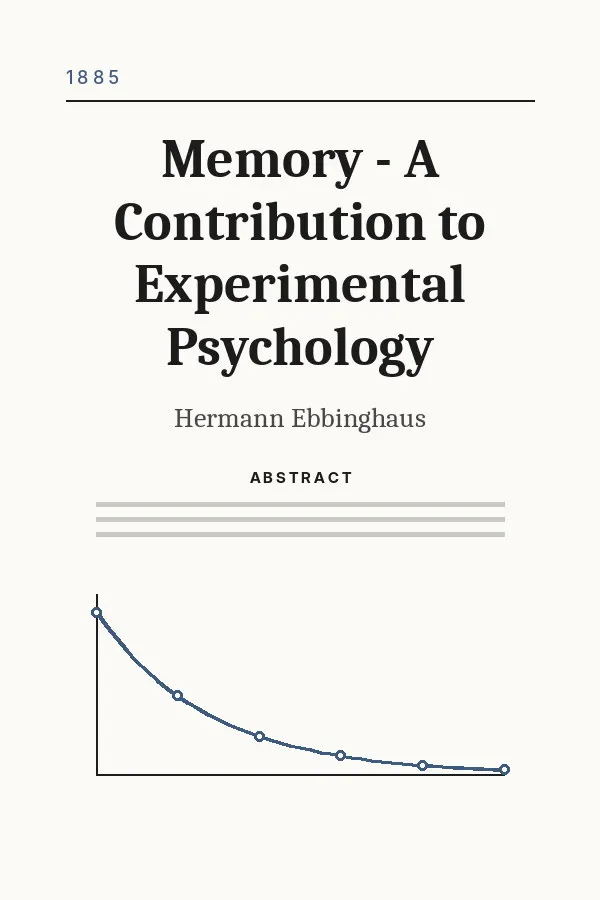
Memory can be measured without asking anyone what they remember. Learn a list until you can recite it once without error, wait, then learn it again: the time saved the second time is the amount retained. Measured that way, loss is steep in the first hour, slower over the first day, and then nearly level for weeks. Repetitions spread over several days hold better than the same number done at once.
The limits, as I read them.
- A sample of one. A trained, patient, professionally interested German professor. See 💡 Ebbinghaus was his own only test subject. Whatever the curve is, it is his.
- Meaningless material, on purpose. The syllables were invented so that nothing would help. My lecture notes are meaningful, connected, and written by me. They should fade more slowly, and I have no idea by how much.
- The neat formula is not in the book. The tidy exponential I keep as 📐 Retention after t days is a later simplification. His own fit was a different and clumsier expression, and he was cautious about it.
- Relearning is not recall. His measure is the effort saved, which is generous: you can save time on a list you could not have recited a word of. An exam asks for recall.
- So what I can honestly take is the shape and not the numbers: steep, then flat, and review early.
⚡QUICK JOTS
- Read on Friday 25 April and Saturday morning, the weekend before starting 🧪 Spaced review of lecture notes. Midterm 68, final in six weeks, and I wanted the source and not the infographic.
- A short monograph from 1885, in the English translation of 1913. I read it fast and checked no wording, so paraphrase only.
- One subject, himself, for years. Lists of invented syllables read aloud to a metronome. It is either heroic or a cry for help.
- Three stars as reading. It is tables, mostly. Five for nerve.
- The famous curve is one small table in the middle. He would be surprised that it is the only thing anyone remembers, and then, being him, not surprised.
🖍️ANNOTATIONS
The savings method
The retention table
On spreading repetitions over days
🧩KEY CONCEPTS
📖LITERATURE NOTES
💎PERMANENT NOTES
🏛️RELATED FIGURES
🏛️ Hermann Ebbinghaus