PAPER
How are habits formed - Modelling habit formation in the real world
🚦 Status🗂️ Library
✍️ AuthorsPhillippa Lally, Cornelia H. M. van Jaarsveld, Henry W. W. Potts and Jane Wardle
🏢 PublisherEuropean Journal of Social Psychology, volume 40
⭐ Rating⭐⭐⭐⭐
🏷️ Topics
researchhabitspsychology
📅 Published2010
❤️ Favorite⭐ Favourite
🛠️USED IN
🔹 Walk before screens🧪 Walk first, write second
🎯CORE THESIS
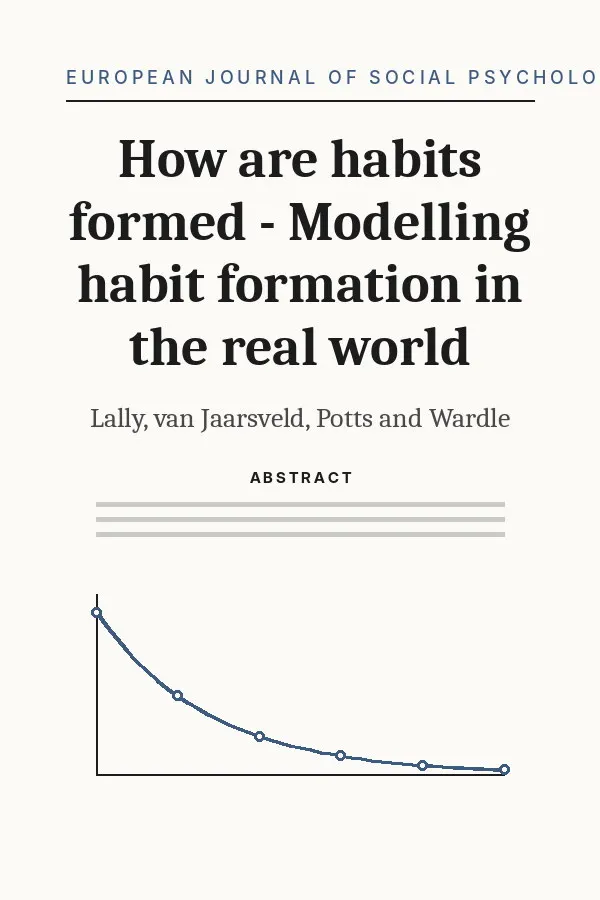
When a person repeats a chosen action in the same setting every day, the feeling that it happens by itself rises quickly at first and then levels off. The time it takes to get near that plateau varies enormously between people and between behaviours, from a few weeks to most of a year. A single missed occasion does not reset the process.
The limits, as I read them.
- Small and self-selected. Ninety-six volunteers recruited at a university began. The curve could be fitted well for only a few dozen of them. The 66 is the median of that smaller group.
- Self-report. Automaticity was measured by a short questionnaire filled in by the participants. Nobody observed anyone eating fruit.
- Twelve weeks. The study ran for 84 days. The upper end of the range, 254 days, is an extrapolation from the fitted curve and not something anyone was watched doing.
- Easy behaviours. A glass of water with lunch levelled off sooner than fifty sit-ups after coffee. Habits like mine, which need shoes and weather, are nearer the hard end.
- One miss, not many. The finding is about a single missed opportunity. The paper is careful not to say that a missed week is harmless, and neither am I.
Kept beside it. The number, with its range attached, is 💡 The median time to form a habit in one study was 66 days. The older view it argues with is 📕 The Principles of Psychology, chapter IV - Habit and its sternest maxim, 💬 Never suffer an exception to occur. The habit I read it for is 🔹 Walk before screens, which began as the trial 🧪 Walk first, write second.
⚡QUICK JOTS
- Read on Saturday 1 March, with eleven boxes in the hall and the spare room half emptied. Finished on Sunday.
- This is the study behind 66 days. I had seen the number on a hundred slides and wanted to know what it was a number of.
- It is a median, from a few dozen people, with a range so wide that the median is almost a courtesy. The paper says so. The slides do not.
- Read five days into 🧪 Walk first, write second, and four days after William James told me never to allow an exception. I wanted a second opinion with data.
- The reassuring part is real: one missed day made no measurable difference. February had four missed walks in it, three of them in the week of the slip. I needed to know whether a week like that sends you back to zero.
🖍️ANNOTATIONS
Method
Results
On missed days
💬QUOTES
🧩KEY CONCEPTS
📖LITERATURE NOTES
💎PERMANENT NOTES
🏛️RELATED FIGURES
🏛️ William James